My Baby Was Born With a Dark Discoloration on Her Foot and Ankle
Have you noticed changes in your babe's skin? Maybe they were built-in with a discolored patch, or yous're beginning to see a weird-looking spot.
Birthmarks are normal. They're part of what makes each of u.s.a. unique.
Some skin discoloration could exist completely harmless and vanish as apace as it appeared. It may be the after-effect of an infection, or in rare circumstances, it could exist acquired by a serious condition.
Y'all or your partner might have a special birthmark, but does that mean your footling one volition likewise have one? Allow'southward look at baby pare discoloration and birthmarks in more detail.
- Baby'due south Skin Color
- Brown Spots And Discoloration
- White Patches
- Yellow Discoloration (Jaundice)
- Birthmarks
- What Causes Birthmarks?
Infant's Skin Colour
In our heads, we all have the aforementioned epitome when we retrieve of a newborn. A chubby-cheeked wonder, with perfect skin. Merely that's not always how it is.
The reality is a newborn baby, fresh from the womb, volition likely be purple and slimy. They may also be covered in white goo, called vernix caseosa.
A infant's skin is newspaper thin. Therefore, ecology changes play a huge role in the color. You'll likely find direct away if your infant is cold — their feet will probably exist a blueish color. Conversely, if they are hot, their cheeks will be cerise and flushed.
Newborns sometimes have a lighter skin complexion than you lot expected. Their pare tone can alter over fourth dimension — some take upward to six months or longer to develop their permanent skin color.
Pro Tip
Birthmarks or skin discoloration may be noticeable on babies when they are first born. Some, notwithstanding, will appear shortly after nascence, or as baby grows older.
Brown Spots And Discoloration
Brown spots could exist more than only freckles. It's not uncommon to find a few when bathing your baby (and yous try to rub it off, simply realize it's on the skin). Don't worry, most baby spots will practise no damage.
Here'southward what might exist causing them:
Cafe Au Lait Macules
Cafe au lait macules, or CALMs, are brown spots or patches. They can appear anywhere on the baby'due south body and are unremarkably present from birth. These spots are found in about three percent of infants.
They're typically randomly and unevenly shaped and can range from one-5th of an inch to i inch in size. They can be dark or light chocolate-brown and may darken with dominicus exposure.
It is possible for the spots to be slightly raised, although they are commonly smooth. Finding one, or even three, on your infant is normal and no reason for concern. Simply if yous find vi or more, you should consult your doctor, to check for NF1.
Neurofibromatosis Blazon i
Alarm
Having more than half-dozen CALMs, peculiarly if yous also find freckles around the armpit or groin, could be a sign of a genetic disorder, called Neurofibromatosis blazon 1(NF1).
Also known as Von Recklinghausen's disease (VRD), this is the most common of three variations of Neurofibromatosis.
NF1 affects about 1 in three,000 babies. It causes tumors to form on the tissues and nerves in the body and on the skin and the growths can trigger many unlike health issues. Symptoms vary widely, even inside members of the same family unit.
The tumors are ordinarily non cancerous. All the same, information technology is necessary to monitor them in example they do become malignant, particularly if they proliferate (ane).
White Patches
Many things tin can cause white patches on a child'due south skin. The almost common is likely to exist a sore or scratch, where the surface has been broken. This produces new skin not even so exposed to the lord's day, which makes it lighter.
All of the states moms have worried when we institute white spots of a sudden appearing on our baby's peel. Only subsequently did we realize information technology was just a scratched mosquito bite or a healing wound.
Nonetheless, white patches or discoloration of the skin tin as well be a sign of vitiligo.
Vitiligo
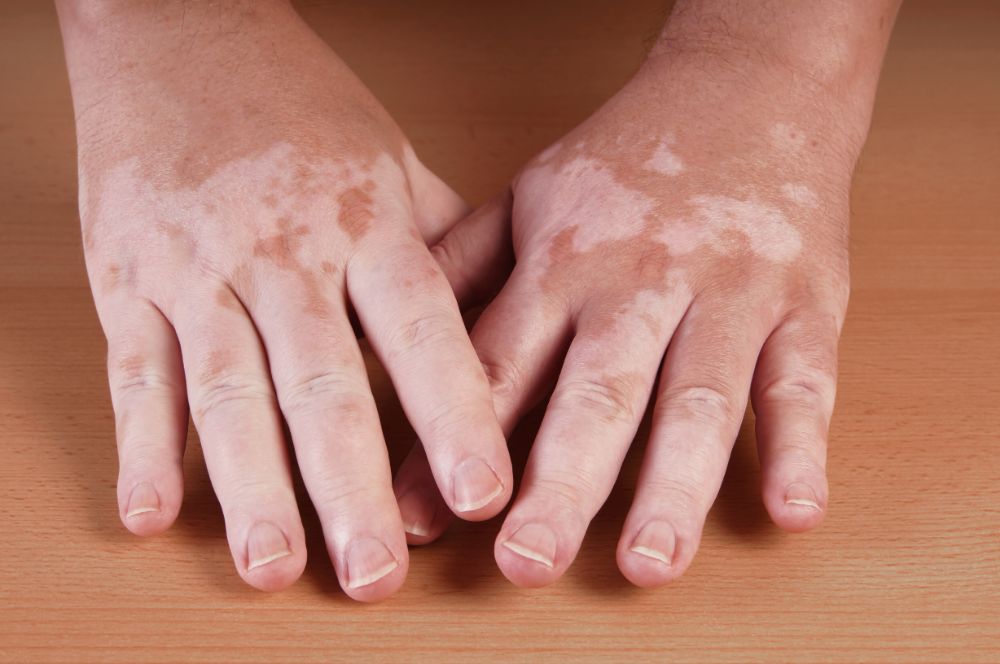 Vitiligo is a condition which causes white spots and patches to develop on the skin. It can be a long-term status which often doesn't go away completely.
The condition event from a loss of pigment, or melanin, in the skin. It can affect people of all ages and ethnicities.
The patches could be any shade, from light to white with a pale pinkish middle. It usually starts effectually the face, neck, or hands, just can occur anywhere on the body.
If your kid has this condition, it is crucial to apply a strong sunscreen on the patches. The loss of paint makes the skin much more vulnerable to sunburn.
At that place are dissimilar types of vitiligo, including segmental, focal, and generalized.
Segmental vitiligo will only touch on 1 side of the body, and focal is just a couple of spots in one surface area. Whereas generalized vitiligo sees symmetrical patches on both sides of the body. This is also considered to exist an autoimmune status (ii).
Tinea Versicolor
Tinea versicolor is a fungal infection of the pare. Information technology shows up every bit patches ranging from white to dark, depending on your child's pare color. If you look closely, you may see tiny scales on the skin's surface.
This condition is very mutual in children and young adults. The mucus prevents the affected skin from tanning, which means the patch will be even more obvious when exposed to the sun.
Pityrosporum ovale is a type of fungus living in the pores. As the condition progresses, the mucus overgrows, causing the discoloration.
In that location shouldn't be any reason for concern since as well being a lilliputian itchy, the patches are harmless.
This status should resolve itself, but if you're concerned, contact your child's pediatrician for further communication (3).
Yellow Discoloration (Jaundice)
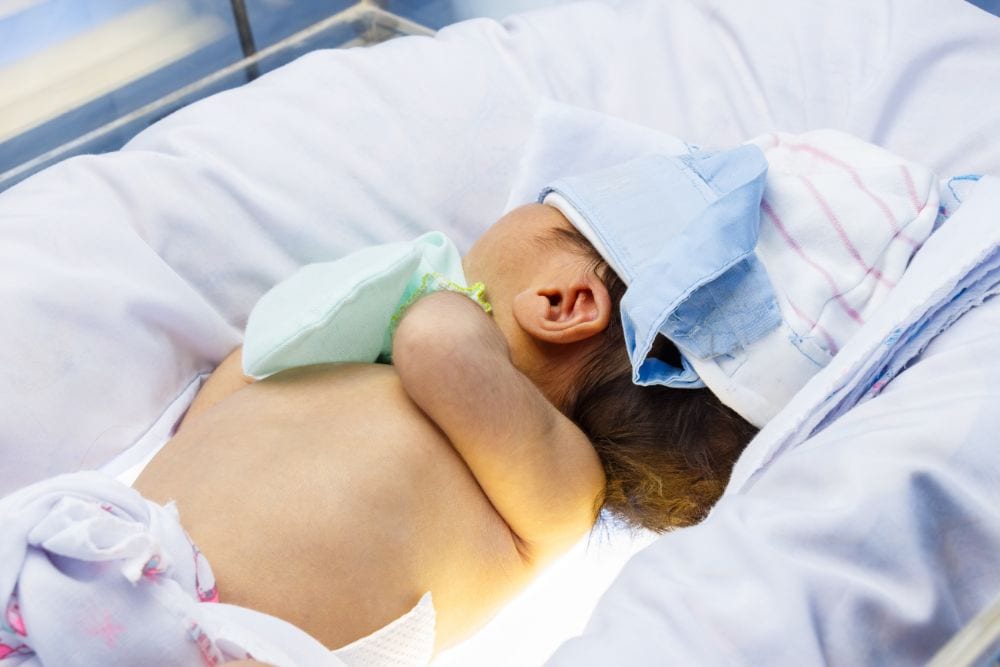 While white or brown spots or patches may seem more normal, seeing your baby plough yellowish can be alarming. But don't panic, your niggling bundle of joy probably just has a touch of jaundice.
Jaundice is a prevalent condition, generally actualization two to three days after nativity. Information technology typically turns the baby'due south skin yellow, and can also affect the whites of the eyes.
Neonatal jaundice occurs due to a buildup of bilirubin in the claret. When red blood cells are broken down, bilirubin is produced. And information technology just happens to take a yellow colour.
Have Annotation
Jaundice is common in newborns considering they have a higher number of reddish claret cells. Their liver is also not fully developed, which makes it harder to remove the bilirubin. The condition is more likely in premature babies or those with low nascency weight.
Jaundice is mostly harmless and ordinarily disappears within i or two weeks.
Nonetheless, if the condition is apparent within 24 hours of delivery, it could be a sign of a more astringent trouble. In this case, yous should consult your doctor.
Treatment for jaundice is usually non necessary. A simple treatment you can do at home is exposing your baby to controlled sunlight for a few minutes each solar day.
Never place your newborn in directly sunlight, though. Instead, use a sparse fabric or curtain to encompass a sunlit window. Sit there with your baby for 10 to fifteen minutes every twenty-four hours.
The dominicus will provide your infant much-needed vitamin D, which helps to intermission down the bilirubin. Equally a mother of babies who both had slight jaundice, I tin assure you this method is very effective.
Severe cases may crave medical intervention, in the form of:
- Phototherapy: Babe is exposed to a detail lite which changes the form of bilirubin, making it like shooting fish in a barrel for the liver to suspension it downward.
- Exchange transfusion: If phototherapy does not work, a complete blood transfusion might be necessary, to reduce the amount of bilirubin in baby's blood.
It is vital to diagnose and treat astringent cases of jaundice correctly. If jaundice is left untreated and bilirubin levels become too loftier, it can atomic number 82 to seizures or permanent brain impairment (4).
Birthmarks
Nosotros all know a birthmark is peel discoloration either present at birth or appearing inside the first month of a babe's life. They come in various colors, shapes, and sizes, and can occur anywhere on the body. Let's look at the most common.
1. Salmon Patch
A salmon patch is a ruddy or pink flat patch which often occurs on the babe's eyelids, brow, or neck.
They usually fade entirely within the outset few months although the patches on the brow can take up to a year or more. My babe looked like a mini Harry Potter for a couple of months, with a little lightning-shaped pink mark on his head.
These patches can become more than visible when the baby cries, every bit they fill up with blood. Salmon patches are benign and no cause for concern.
two. Infantile Hemangioma
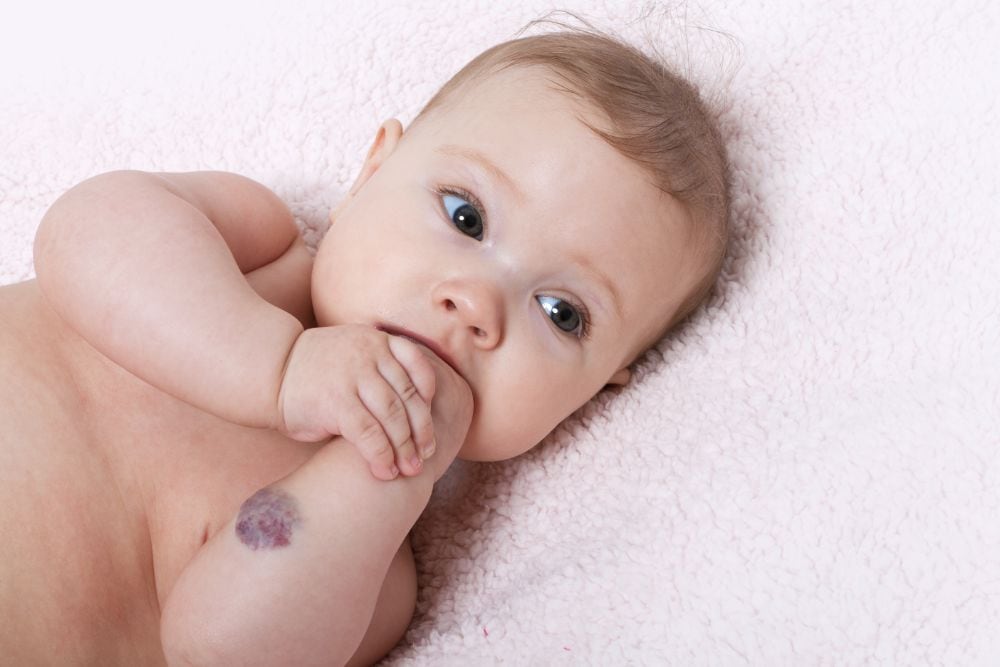 These are besides known as strawberry birthmarks. Unsurprisingly, they actually look like strawberries. Infantile hemangiomas can appear anywhere on the trunk and may as well develop deeper in the skin, making it wait blueish or purple.
Strawberry marks are strangely more common among girls than boys. They usually start outgrowing very quickly in the starting time few months. They and then decrease in size and near disappear eventually, although this could take several years.
These birthmarks are non harmful. Nonetheless, if they interfere with feeding, vision, or any other vital office, consult a specialist for advice (5).
3. Mongolian Spots
A Mongolian spot is a blue-gray, bruise-looking birthmark, which is present from birth. It is as well known every bit a slate greyness nevi. The formal term for slate greyness nevi is congenital dermal melanocytosis.
These strange looking spots are quite common in darker-skinned people. They are mostly found on the lower back or buttocks but tin can occur anywhere.
Mongolian spots tin can last for months, or even years. Just they usually disappear equally the child gets older (six). The marks are frequently mistaken for bruises, which is what I did when I saw my friend'due south daughter had one!
4. Capillary Malformation
Capillary malformation, as well known as a port vino stain, is a flat ruby or royal mark. These marks vary in size. Some are but a fraction of an inch, while others cover large areas.
Port wine stains may darken over time, and your child volition well-nigh likely be affected by information technology for life. In that location are ways to lighten it, though, with specialist laser technology.
These marks also tend to flare upwards and become more than visible with changes in hormone levels. This could exist around puberty, pregnancy, or menopause (7).
What Causes Birthmarks?
It'south not completely clear why birthmarks announced. In that location are two sorts of birthmarks (viii).
one. Vascular Birthmarks
These types of marks are caused by abnormal blood vessels in, or fifty-fifty under, the peel. They include port vino stains and strawberry marks.
Vascular birthmarks go their size and color because of the nerves which command the size of the vessels.
Considering these nerves don't function properly, they allow blood to be supplied to the expanse constantly. This results in the bright red or purple colour you run across.
2. Pigmented Birthmarks
These are acquired by a cluster of pigmented cells in the pare. Pigmented birthmarks are usually apartment, and some tin be a footling raised. They include Mongolian spots and CALMs.
My Baby Was Born With a Dark Discoloration on Her Foot and Ankle
Source: https://momlovesbest.com/baby-skin-discoloration
0 Response to "My Baby Was Born With a Dark Discoloration on Her Foot and Ankle"
Post a Comment